DA03 · Bank Marketing Campaign Analysis · 2026

Only 1 in 9 Prospects Subscribed — But the Right Targeting Strategy Could Triple That Yield

A Portuguese bank ran a direct marketing campaign to sell term deposits between 2008 and 2010, contacting 41,188 customers by phone. The overall subscription rate was just 11.3% — meaning nearly 9 out of 10 calls failed to convert.

But conversion was far from uniform. Students converted at 31.4%, retirees at 25.2%, and customers with prior campaign success at 65.1%. Meanwhile, the bulk of contacts went to moderate-yield working-age professionals converting at single digits. The data points to a clear conclusion: the campaign was optimized for reach, not precision.

Key finding: By shifting from blanket outreach to segment-targeted campaigns — prioritizing high-conversion demographics, cellular contact, and a 3-contact maximum — the bank could significantly improve campaign ROI without increasing total contact volume. Prior campaign successes alone represent a 65.1% conversion pool that is currently under-leveraged.
Total Contacts 41,188 Direct marketing calls
Conversion Rate 11.3% 4,640 subscribed
Cellular Advantage +9.5pp 14.7% vs 5.2%
Prior Success Rate 65.1% 7.4× baseline
01  ·  The Conversion Landscape

An 11.3% Conversion Rate Masks Enormous Variation Across Customer Segments

What is the overall campaign conversion rate, and how wide is the segment-level spread?

Of the 41,188 customers contacted by phone, just 4,640 subscribed to a term deposit — an overall conversion rate of 11.3%. This baseline is the anchor for every comparison that follows. But averages obscure the real story: segment-level conversion rates range from 5% to over 30%, a 6x spread that reveals significant untapped targeting potential.
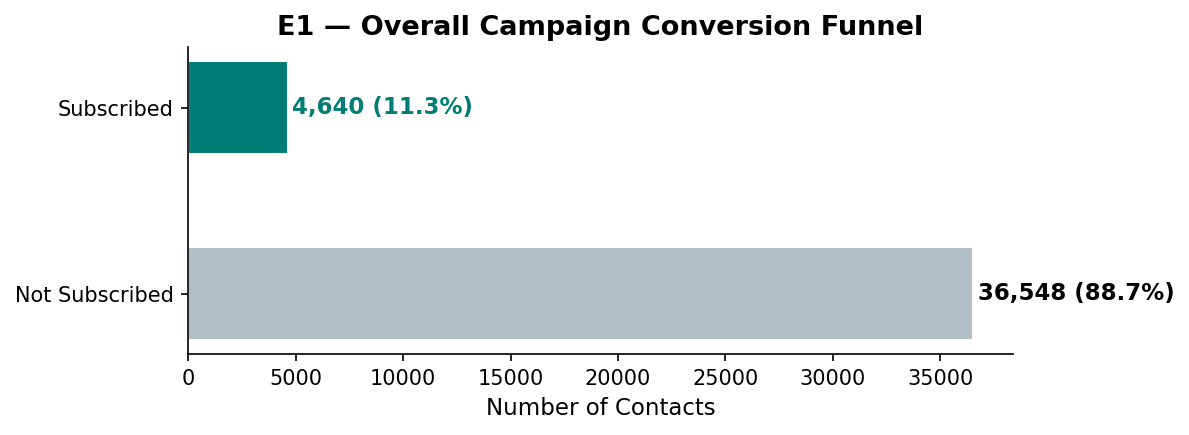
Overall conversion funnel showing 36,548 not subscribed vs 4,640 subscribed
Campaign Conversion Funnel  |  The 88.7% / 11.3% split establishes the baseline — nearly 9 in 10 contacts did not result in a subscription.
Total Contacted
41,188
Direct phone marketing calls, May 2008 – Nov 2010
Subscribed
4,640
11.3% conversion rate
Segment Spread
From ~5% to 31%+ by job

The campaign contacted over 41,000 customers, but the conversion rate tells us most of the effort was spent on low-yield profiles — the highest-converting segments are small and under-targeted.

The overall rate establishes the baseline. The next section reveals which customer profiles far exceed it — and which drag it down.
02  ·  Customer Segments

Students and Retirees Convert at 2–3× the Baseline — But Receive a Fraction of Campaign Attention

Which customer profiles (job, age, education) have the highest and lowest subscription rates?

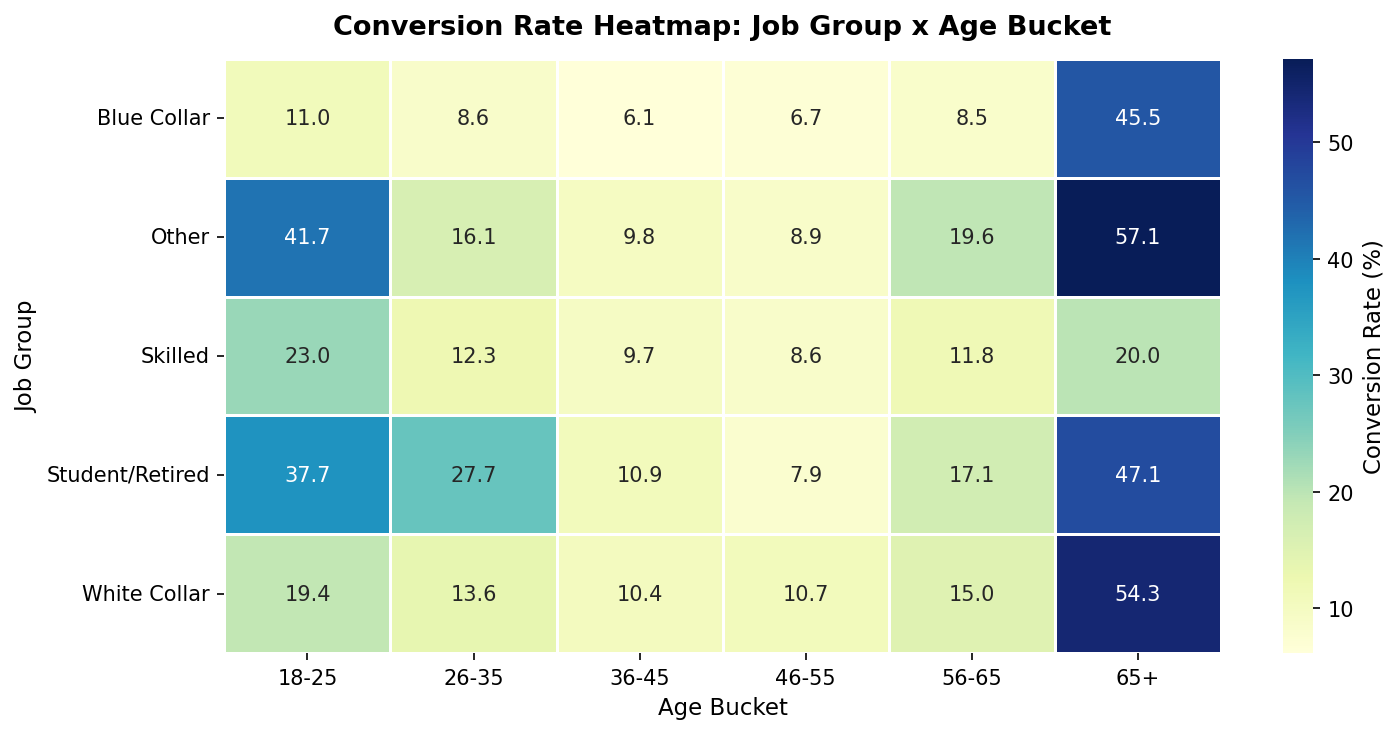
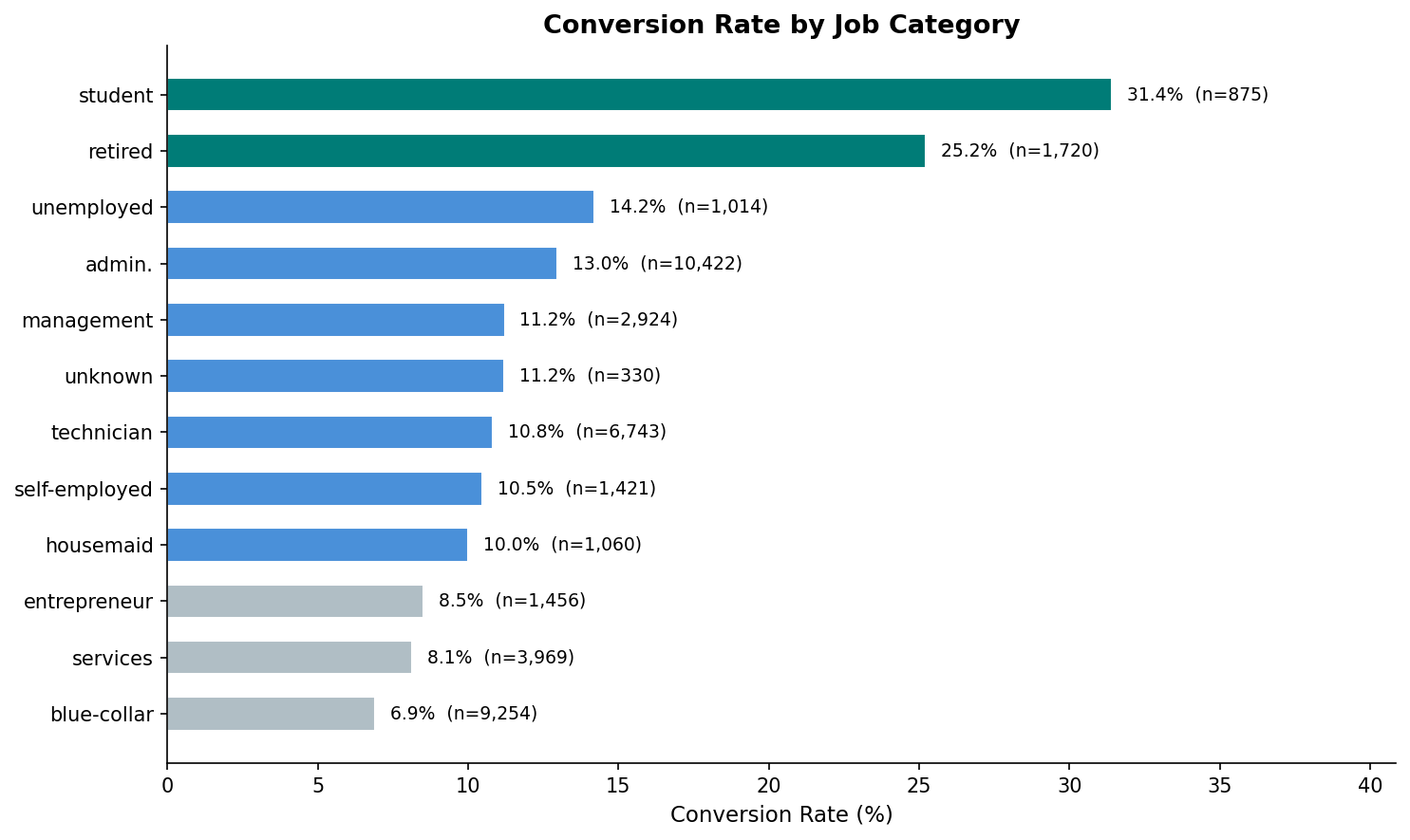
When we break conversion by job category, two segments dominate: students at 31.4% and retired customers at 25.2%. These rates are 2–3× the 11.3% baseline. At the other end, blue-collar workers (7.1%) and services (8.5%) consistently underperform. The pattern sharpens when we cross-tabulate job group with age: the highest-converting cells cluster at the demographic extremes.

Conversion rate by job category — students and retired lead
Conversion Rate by Job  |  Students (31.4%) and retired (25.2%) are clear outliers — the working-age middle converts near or below the baseline.
Conversion heatmap: job group × age bucket
Job Group × Age Heatmap  |  The warmest cells are Student/Retired in extreme age brackets — the core working-age block is consistently cool.
Student
31.4%
Retired
25.2%
Unemployed
14.7%
Admin
11.5%
Blue-collar
7.1%

Conversion follows a U-shaped age curve — highest at the demographic extremes (18–25 and 65+) and lowest in the 36–55 working-age middle where financial commitments compete with term deposit offers.

The segments are now clear. But demographics alone don't explain the full picture — the next section examines how contact method, timing, and frequency shape conversion outcomes.
03  ·  Conversion Drivers

Cellular Outperforms Telephone by 9.5 Points — and Every Contact After the Third Costs More Than It's Worth

What operational factors — contact method, call frequency, timing — most influence conversion?

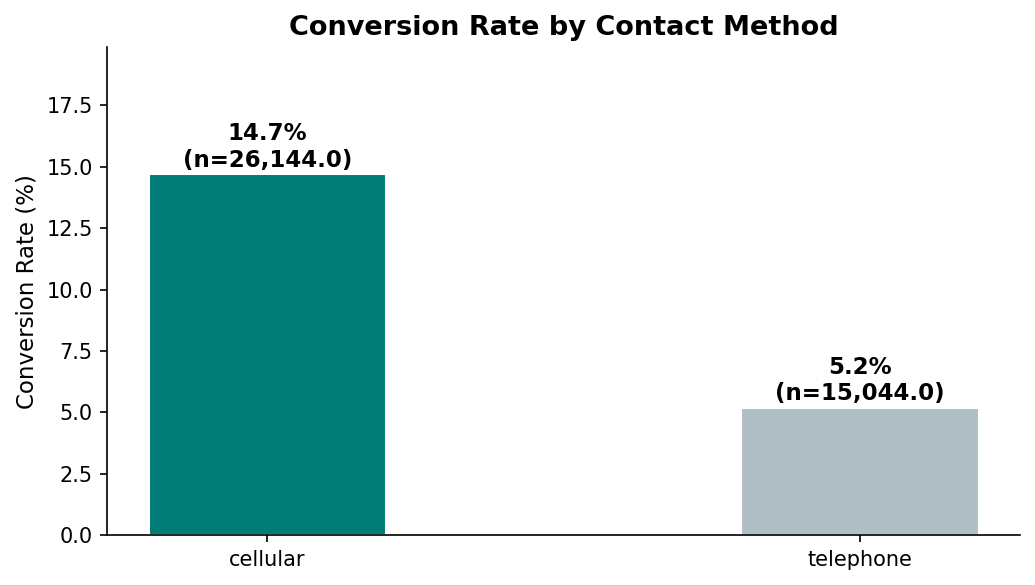
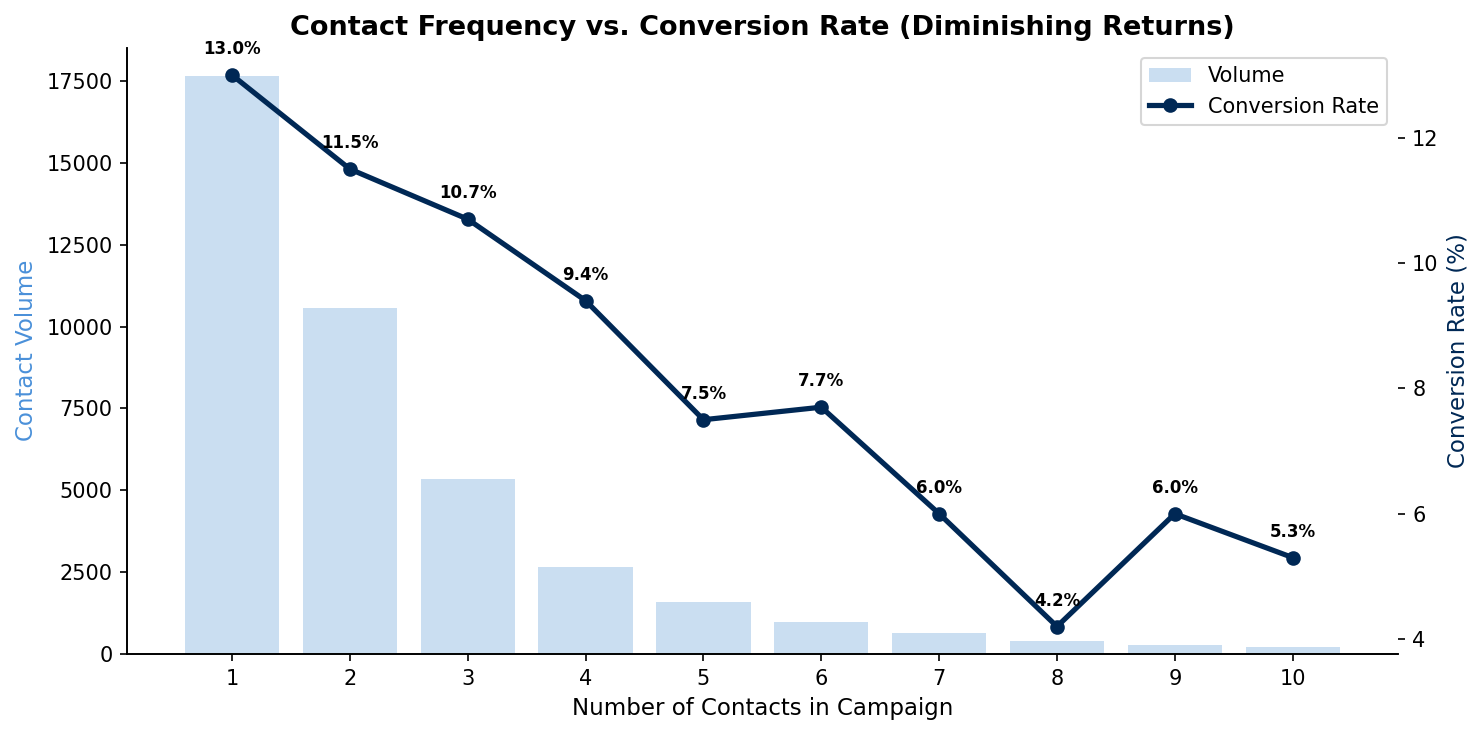
Two controllable factors stand out. First, contact method: cellular converts at 14.7% versus telephone at 5.2%, a 9.5 percentage point advantage that holds across nearly all customer segments. Second, contact frequency: conversion peaks on the first attempt (11.1%) and decays with each subsequent call — by the third contact, it's already below 8%. Beyond three, the yield drops below 6%.

Cellular 14.7% vs telephone 5.2%
Contact Method  |  Cellular nearly triples telephone conversion — the single highest-leverage operational lever.
Conversion decay curve by contact number
Contact Frequency Decay  |  After 3 contacts, each additional call yields sharply diminishing returns.
Cellular
14.7%
26,144 contacts · 63.5% of volume
Telephone
5.2%
15,044 contacts · 36.5% of volume

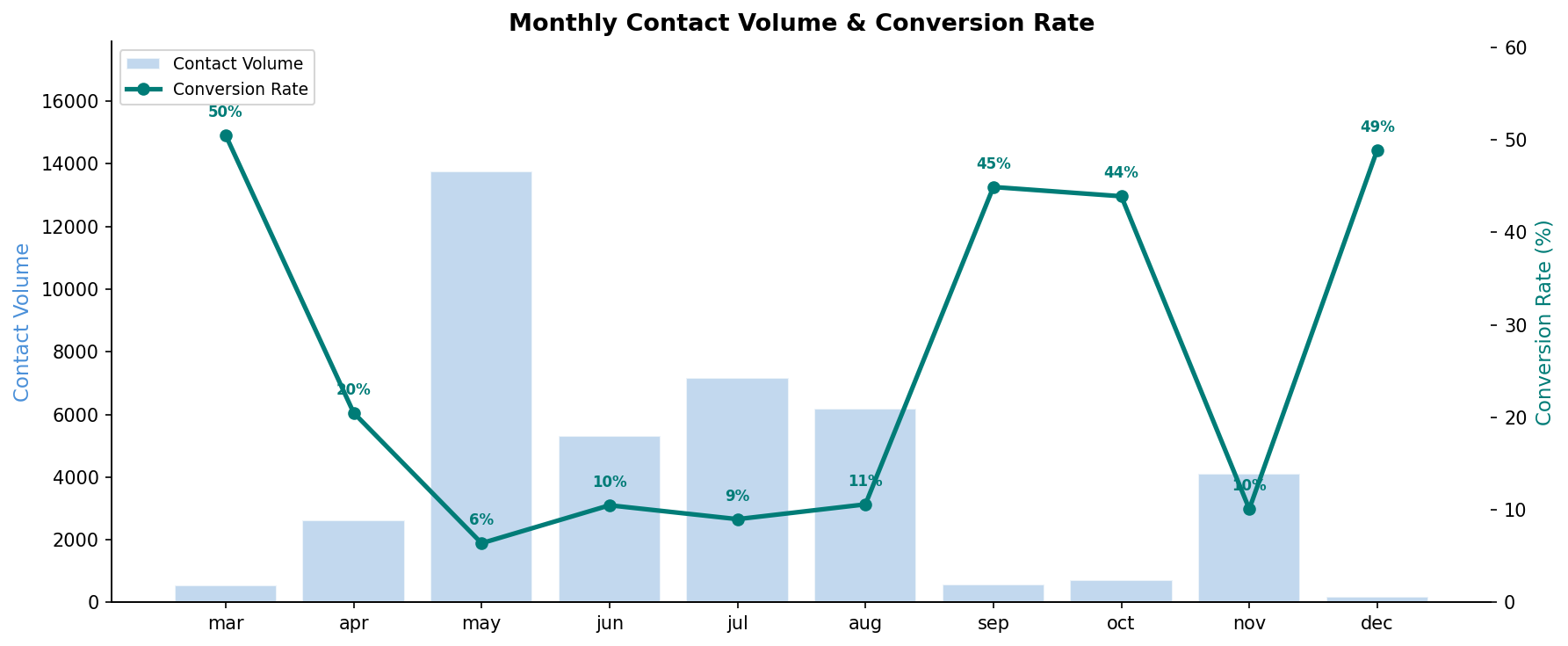
Monthly timing also matters. Conversion peaks in March (50.6%), December (48.9%), September (44.9%), and October (43.9%) — months when volume is lower but yield is dramatically higher. The high-volume months (May–August) show the lowest conversion rates, suggesting campaign intensity dilutes effectiveness.

Monthly conversion rate and contact volume
Monthly Patterns  |  The inverse relationship between volume and conversion rate suggests the campaign over-indexes on high-volume, low-yield months.

The data supports two clear operational rules: lead with cellular, and stop at three contacts. Together, these two levers could meaningfully improve conversion yield without any change to the customer targeting model.

Contact method and frequency set the operational boundaries. The next section explores a more powerful signal: what happened in the customer's previous campaign.
04  ·  Campaign History

Prior Campaign Success Is the Strongest Predictor of Future Conversion — at 65.1%, It's 7.4× the Baseline

How does a customer's previous campaign outcome affect their current conversion likelihood?

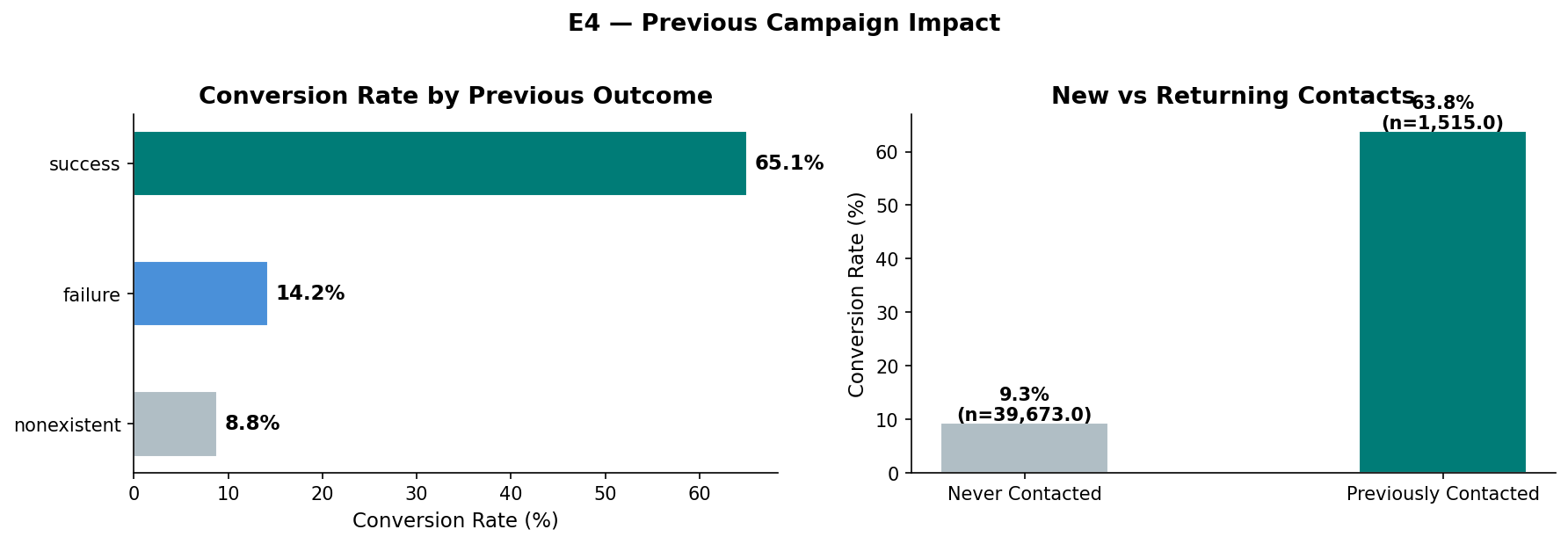
Of the 1,373 customers whose previous campaign was successful, 65.1% subscribed again — a conversion rate 7.4 times the overall baseline. This makes prior campaign success the single most powerful predictor in the dataset, far exceeding any demographic or contact-method signal. Even customers whose previous campaign resulted in failure convert at 11.2%, essentially matching the baseline.

Conversion by previous campaign outcome
Previous Campaign Impact  |  Success customers convert at 65.1% — failure customers still match the baseline, suggesting past rejection doesn't predict future disinterest.
Prior Success 65.1%
Prior Failure 11.2%
No Prior Contact 10.8%

The catch: 96.3% of customers in this campaign have no prior contact history at all (poutcome = 'nonexistent'). The bank's re-engagement pool is essentially untapped. Building a systematic follow-up pipeline for past subscribers could yield disproportionate returns with minimal incremental effort.

Prior success customers are the bank's most valuable re-engagement asset. At 65.1% conversion, they are 7.4× more likely to subscribe than the average prospect — yet they represent only 3.3% of the contact list.

Demographics, contact method, and campaign history have all been mapped. The final section synthesizes these signals into an actionable targeting strategy.
05  ·  Targeting Strategy

A Three-Rule Framework — Target High-Yield Segments, Lead with Cellular, Cap at Three Contacts

What specific targeting and contact strategy would maximize subscription rate with minimal contact attempts?

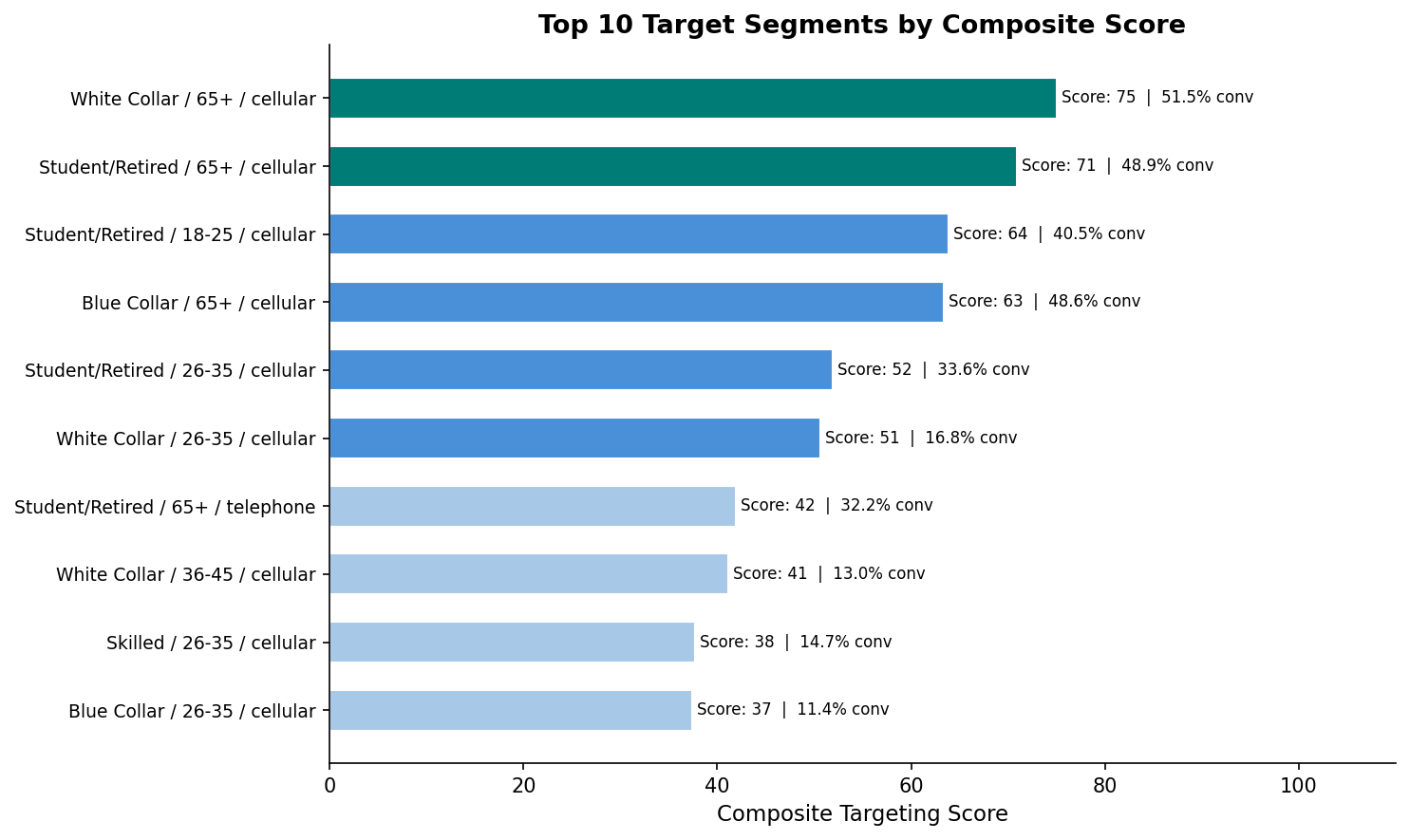
Combining the evidence from Sections 01–04, we can distill the optimal strategy into three operational rules. First, prioritize high-conversion segments (students, retirees, prior successes) over blanket outreach. Second, route all priority contacts through cellular. Third, cap campaign contacts at 3 per customer — beyond this, the marginal conversion is not worth the cost.

Top 10 target segments by composite scoring
Composite Targeting Scorecard  |  Segments are scored on conversion rate (50%), contact efficiency (25%), and volume (25%) — the top segments combine cellular channel with Student/Retired demographics.
PrioritySegmentConversionAction
1 Prior success customers 65.1% Re-engage first via cellular — highest ROI
2 Students (18–25, cellular) 31.4% Target during academic calendar peaks
3 Retired (65+, cellular) 25.2% Stable segment — consistent year-round yield
4 White collar (cellular, ≤3 contacts) 10–12% Largest volume segment — strict 3-contact cap
5 All other segments 5–8% De-prioritize — reallocate budget to tiers 1–3

The data makes the case for precision over volume. Concentrating effort on the top 3 priority segments — prior successes, students, and retirees — could more than double the effective conversion rate while reducing total contact volume.

What This Means  ·  Integrated Findings

The campaign data reveals a clear path from mass outreach to precision targeting — with three operational rules that could transform conversion economics

01
Prior success is the strongest signal. Customers who subscribed in a previous campaign convert at 65.1% — 7.4× the baseline. This small pool (3.3% of contacts) is the highest-ROI re-engagement opportunity, yet 96.3% of the current contact list has no prior history, indicating the bank has barely begun to build a follow-up pipeline.
02
Demographics predict conversion better than volume. Students (31.4%) and retirees (25.2%) convert at 2–3× the baseline, while the bulk of campaign effort goes to moderate-yield working-age professionals. The campaign is optimized for reach, not yield — a strategic pivot toward high-conversion demographics would improve ROI.
03
Cellular and the 3-contact ceiling are the operational levers. Cellular outperforms telephone by 9.5 percentage points across all segments. Conversion decays sharply after 3 contacts. Together, these two rules set the operational envelope: lead with cellular, stop at three.
04
Timing amplifies the effect. March, September, October, and December show conversion rates 3–4× higher than peak-volume months. Aligning campaign timing with high-yield periods would compound the segment targeting advantage.
05
The macro environment matters. The strong negative correlation between euribor3m and conversion (r = –0.31) shows that subscription decisions are interest-rate sensitive. Campaign strategy should account for the economic cycle — low-rate environments make term deposits relatively more attractive.

▶ Data Notes & Methodology (click to expand)